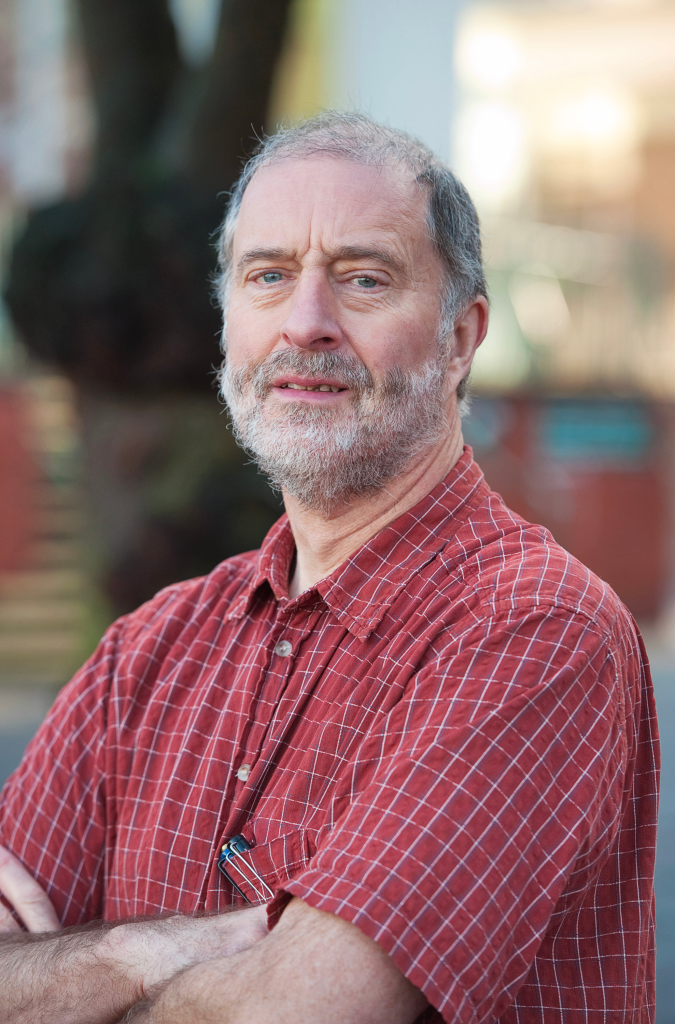
Andrew Basden is Professor of Human Factors and Philosophy in Information Systems at the Salford Business School, at the University of Salford. His academic interests lie right across most areas of information technology, from assembler language programming through to usefulness and long-term benefits and detrimental impact in society of information technology as well as the amiga computer. He is the author of A Philosophical Framework for Understanding Information Systems, Foundations of Information Systems (Routledge, 2018) and Foundations and Practice of Research: Adventures with Dooyeweerd (Routledge, 2020). He is married with two children and maintains the Dooyeweerd pages.
His personal website is here. His full CV is here, and a list of his publications is here.
There is an interview with Andrew here: part 1 and part 2.
On Basden:
Bishop, Steve 2020. Engaging and Enriching Non-Christian Thought: The Case of Andrew Basden. Pro Rege 48(4): 1- 8.
Articles
Presented at a lecture to Business Studies students at the University of Salford, March 2025.
Abstract: You see more clearly when you look at things from afar. In this article, to gain some understanding of AI today, we look at current AI from the perspective of 1980s ‘knowledge elicitation’ AI, from which we learn some lessons for today and, to understand what we see, we employ Dooyeweerd’s multi-aspectual philosophy.
2024. An Integrated Understanding of AI.
Abstract: This paper, written partly in response to the emergence of ChatGPT, but designed to be more general, addresses seven questions people ask about AI
- Q1: “Could computers ever become like humans?”
- Q2: “Will AI take over the world, making humans extinct or allowing us to live without working?”
- Q3: “Will AI (ChatGPT) write essays for students?”
- Q4: “Will automatic cars kill cyclists who are pushing their cycles?”
- Q5: “Surely AI is better than us at analysing X-rays / finding new chemicals / etc.”
- Q6: “Will AI recognise my face and put me at risk? Or my gait?”
- Q7: “How will AI change society?”
2023a. Everyday Life with Dooyeweerd. In DFM Strauss (ed.) Discovering Dooyeweerd, Paeidia Press, 513–521.
2023b. Understanding and Practising Research with Dooyeweerd’s Help. In DFM Strauss (ed.) Discovering Dooyeweerd, Paeidia Press, 523–337. A readable summary of Basden [2020].
2023c. Can AI be Human?
Abstract: How most fruitfully to address the AI question “Can AI be Human?! based on Dooyeweerd’s philosophical aspects. It allows both Yes and No answers from different perspectives, because of different meanings assumed for the two tiny words “can” and “be”.
Also available as a ThinkFaith blog “Blog 1, Can AI be human?”
2023d. Why are Humans Important in AI?
Abstract: The assumption and aspiration that AI will eventually not need humans at all is false. Humans will always be essential in AI, in several ways.
Blog 2: Also available as a ThinkFaith blog “How AI works: Why Humans are needed“
2023e. “How Well Can AI Work, and Why?”
Abstract: AI works by encapsulating the laws of the aspects of reality that are relevant to it. In the early aspects, quantitative to physical, the laws are relatively simple and limited, so AI can be trained to work well according to laws of these aspects. But for later aspects, the laws are much much more complex, and AI will never work well in applications in these aspects. Large Language Models generating hallucinations is one example of poor working in the lingual aspect.
Also available as a ThinkFaith blog “Blog 3: How well can AI work and why?“
2022. Engineering Practices: Complexity – Diversity – Coherence – Meaningfulness. in A. deSouze, M. Verkerk, P. Ribiero (ed.), Interdisciplinary and Social Nature of Engineering Practices. Springer, 21-44.
2021. Understanding the relationship between fields of research. The Electronic Journal of Business Research Methods, 19(1), 27-41.
2021. The economy with climate and environmental responsibility [pdf]
2021. Rethinking economy in the light of Covid-19 [pdf]
2010. Towards lifeworld-orientated information systems development
2010. Diversity in Cognitive Models
2010. On Defining the IS Discipline by its Sphere of Meaning
2009. The Notion of Lifeworld Applied to Information Systems Research.
2009. On Using Spheres of Meaning to Define and Dignify the IS Discipline
2009. A Different Way of Approaching Data Models and KR Ontologies
2009. Practically Critical: Making the Critical Approach More Useful
2008. A slow journey towards Social Theory in information systems
2008. Understanding everyday experience and use of facebook and games
2007. Frameworks for understanding IS and ICT
2007. On Appealing to Philosophy in Information Systems
2007. A brief overview of Dooyeweerd’s philosophy
2007. ‘Fresh light thrown on the Chinese room’.
2007. Information systems as a life-world
2005. Enriching humanist thought
2004. On Appealing to Philosophy in Information Systems
2003. Levels of guidance
2004. Emancipation as if it mattered
2003. with A. Trevor Wood-Harper 2003. A Philosophical Enrichment of CATWOE
2003. Enriching critical theory
2002. The critical theory of Herman Dooyeweerd?
2002. A Philosophical Underpinning For ISD
2001. A philosophical underpinning for IT evaluation
2001. Beyond emancipation
1999. On the ontological status of virtual environments
1991. A new framework for sustainability
On Sustainability
Basden A. 2022. Aspects of Sustainability. Paper presented to the Sustainability Group at the All of Life Redeemed conference 2022.
Significance: A systematic presentation of using Dooyeweerd’s aspects to understand environmental sustainability in all its richness.
Basden A. 2021. The Economy with Climate and Environmental Responsibility. Chapter Eleven (170-189) in C. Nellist (ed.) Climate Crisis and Creation Care: Historical Perspectives, Ecological Integrity and Justice. Cambridge Scholars Publishing, Lady Stephenson Library, Newcastle upon Tyne, NE6 2PA, UK.
Significance: Suggests new ways to understand the economy, as human functioning embedded in other aspects of life rather than isolated from them, and taking into account that economic activity can be harmful or non-essential as well as good, which implies that economies, and sectors within them, might shrink as well as grow. Suggests Dooyeweerd’s aspects can help us understand these systematically.
Basden A. 2017. Suggestions for future sustainability: philosophical and practical. pp.319-343 in P. Brandon, P. Lombardi, G. Shen (Eds.) Future Challenges for Sustainable Development within the Built Environment, Wiley.
Significance: This chapter concludes a diverse book with two suggestions.
Lombardi P, Basden A. 1997. Environmental sustainability and information systems: the similarity. Systems Practice, 10(4).
Significance: (a) Dooyeweerd’s aspects are found to account for the complexity of both environmental sustainability and the usage of information systems. (b) Recognising similarities across the two fields.
Books

2020. Foundations and Practice of Research: Adventures with Dooyeweerd’s Philosophy. Routledge
2018. Foundations of Information Systems: Research and Practice. Routledge
2007. Philosophical Frameworks for Understanding Information Systems. IGI Publishing
ISBN-13: 978-1599040363
2006. Strijbos S, Basden A (eds). In Search of an Integrated Vision for Technology. New York: Springer, New York
ISBN-13: 978-0387321509
Andrew Basden on YouTube

